
Feed and its role in animal nutrition, your health, and the environment
Pig feed may seem like an underwhelming topic for a blog but I hope you’ll give this a read and gain some new perspective or clarification on questions you had. Many customers ask some version of the question “What do the pigs eat?”. Some ask in a very innocent and curious way, as they’ve probably never thought about it, and are genuinely curious. Others ask to determine if our pork is the right fit for their nutritional needs or desires. I’ll answer that question in this blog and take it a step further to address a much broader view on feed.
Before you read any further I’ll put out a disclaimer: this blog is a long one and the aim is to educate and also clarify our stance on the topic of feed and crops like corn and soy. Our stance on this will not likely change and yet I’ll admit we are always learning and reflecting on our decisions for our farm. If it does change a follow-up blog will be in order and we’ll gladly share how we got there.
Okay back to the blog…
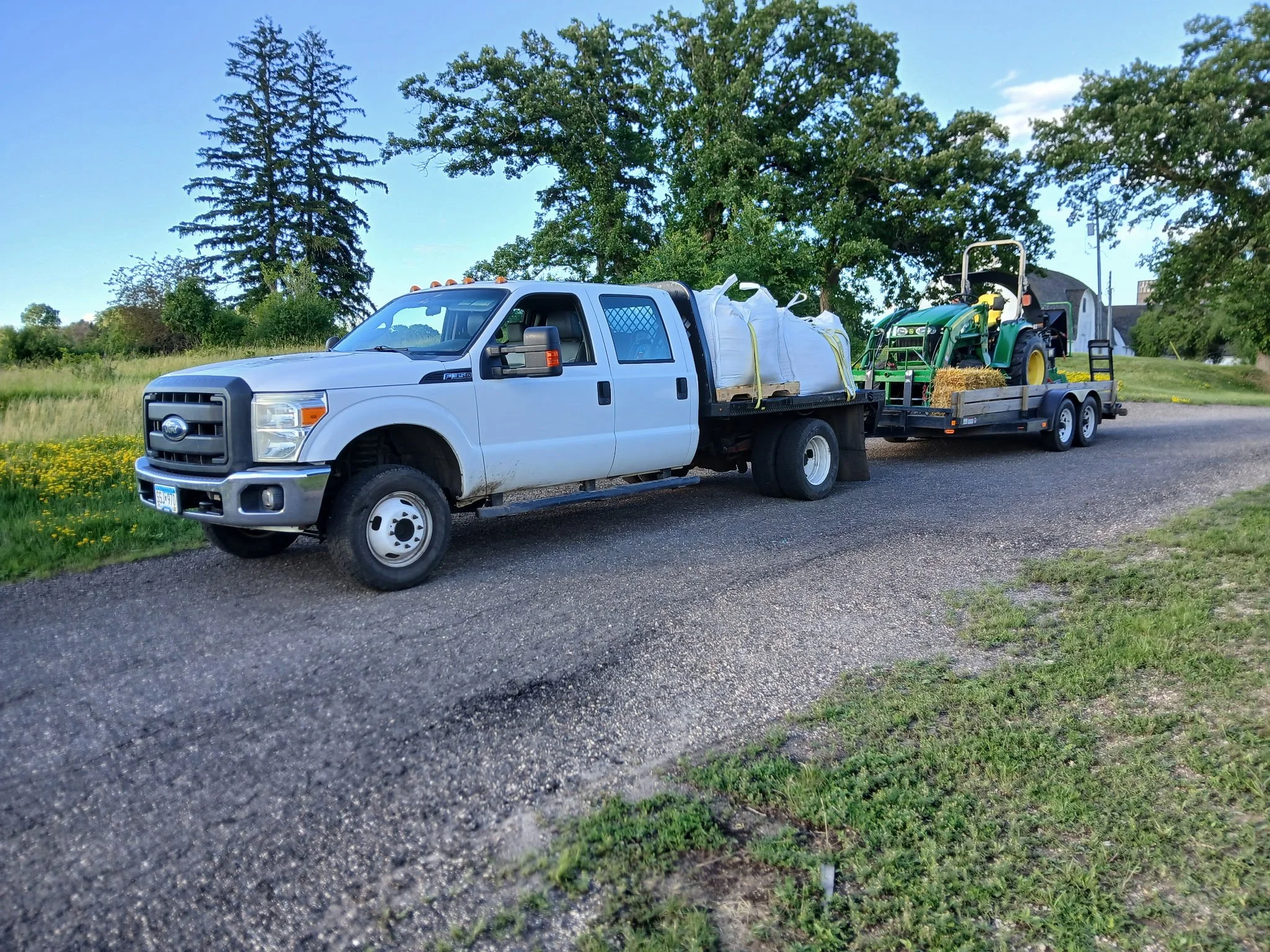
We just restocked with fresh feed from our farmer in Mora. Typically this requires a trip with the flatbed truck to get the feed, then a trip down to the park with the trailer and tractor in tow. We are grateful for the help of a friend, who was headed there to get some feed for their homestead, and offered to haul ours back with his trailer. This is a favor we’ll return on the next trip and is a good example of local community at work. This arrangement cuts drive time and fuel usage in half and it even saves our farmer time since he loaded two orders at once.
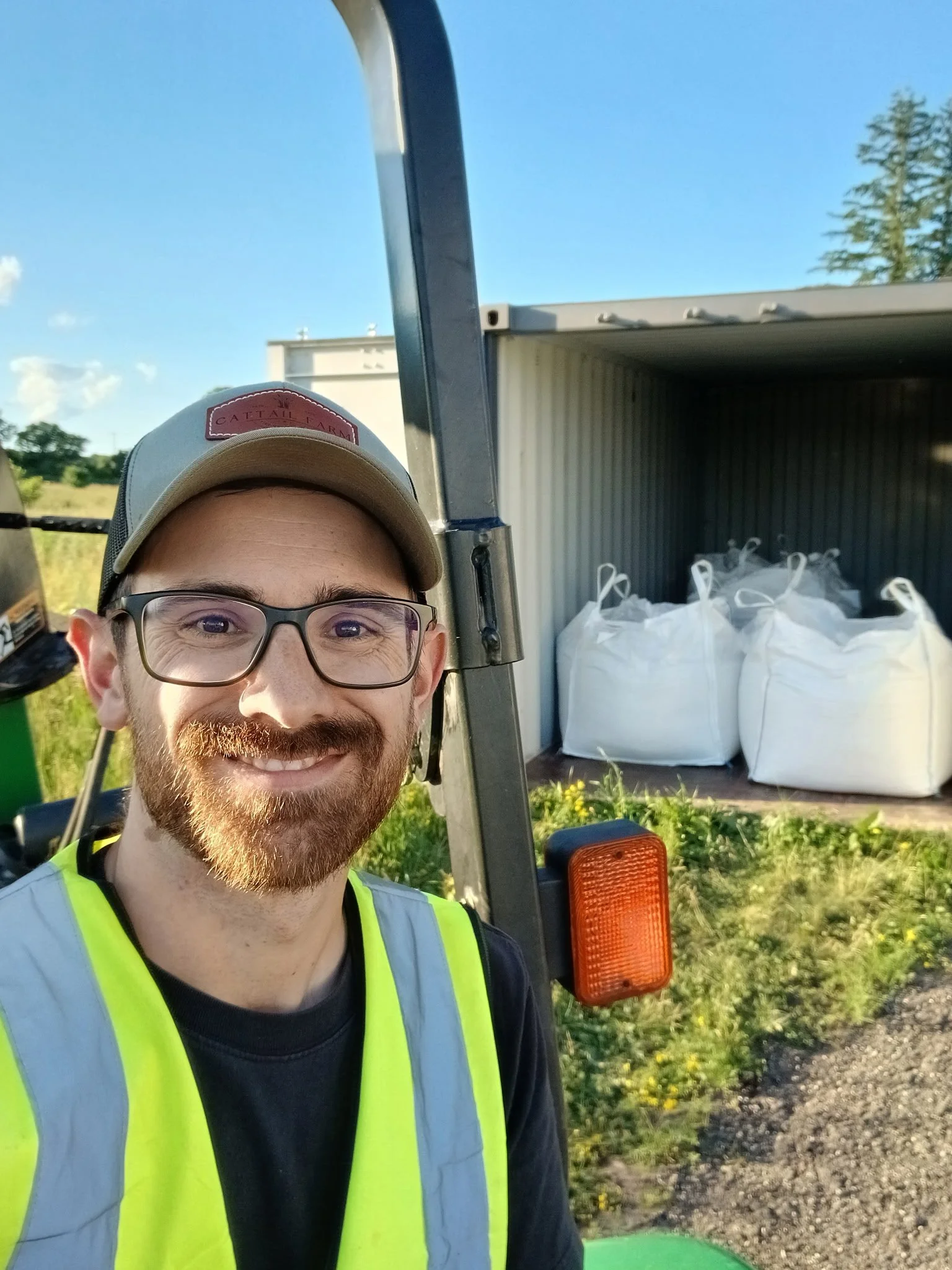
After we got feed from our friend, we loaded it onto the truck and loaded up the trailer and the tractor. Once at the park we unloaded the tractor and then transferred feed from the truck to our rental storage container which keeps it dry and safe from rodents. This batch of 4,000lbs will last 7-8 weeks and during that time it will be out of the sun and rain, sealed up tight in the vinyl bags and storage container. Every couple weeks we’ll fill the pigs’ gravity feeder which also keeps the sun and rain off the feed.
These are all important practices in our feeding regimen and a segue into the topic of feed and understanding its role in animal nutrition, the environment, and your health.
Our hog feed is grown by a local farmer who is certified organic. Beyond the certification he is passionate about building healthy soil and producing high quality feed. He grows corn, soybeans, and sunflowers, then purchases barley from a neighboring organic farmer. These ingredients along with a swine mineral mix are milled fresh for us when we order. We aim to order only enough feed to get us through a couple months. This ensures that the feed is fresh and yet is still a frequency we can manage with our busy schedule as parents and part time farmers.
On the topic of animal nutrition - the corn, barley, and sunflower seeds are all milled raw and offer accessible nutrition for hogs without further processing. Corn is an excellent source of energy while the barley offers additional protein, fiber, vitamins, and minerals. The black sunflower seeds are a great source of protein, fiber, and fat. Finally there is the soybean which is the primary protein source in our feed. More on the soybean below, as it’s use in animal feed has become a controversial topic, but one thing I’ll comment on now is the soybean’s nutrition is most accessible when roasted. Our farmer roasts on farm and does so right before milling feed. This means the fat/oil in the beans is fresh, preventing rancidity, and it also reduces fuel costs and eliminates additional links in the supply chain by not bringing in a contracted roaster.
On the topic of human health - there is growing concern with the use of soybeans in livestock feed. Some concerns are ecological, while most are related to human health. There is too much to unpack here in a blog post but I do want to share a few factors in our decision to use soybeans in our feed.
Let’s start with a concern with phytoestrogens. Folks are concerned with health issues related to over exposure of phytoestrogens and therefore seek to eliminate them from their diet. To that I’ll repeat a phrase my father has said hundreds of times in my life “everything in moderation”. I’ve always understood the meaning behind this saying to be twofold; first is that too much of anything can be detrimental and second is that our bodies are resilient and a little bit of something that may not be “perfect” for our system will not have an adverse effect. Now I didn’t say a little bit of something that is toxic or bad for our system and I don’t believe that was my fathers meaning either. But this is the thing with the soybean and it’s phytoestrogens - they’re natural. The soybean, which is a domesticated version of a wild plant, has fed livestock, who then fed people, for thousands of years. I do not believe we should dismiss a plant that has a proven track record for supporting cultures for millennia. I also do not intend to discredit those suffering from health issues that are linked to overexposure of phytoestrogens or any other naturally occurring nutrients in the soybean. But this brings me to another point on moderation. The soybean historically has fed livestock, while today it’s oil and other byproducts can be found in nearly all of the processed foods on our grocery store shelves. We must acknowledge this issue; soy and also corn are overused in our food system. I believe reducing consumption of soy by-products from processed foods is a logical step for everyone, as those are an industrial and unnatural version of the plant. I think taking the reduction to the point of not feeding it to animals is a stretch and should be carefully evaluated along other factors which I’ll get into below.
Another concern is with the environmental impact of growing corn and soybeans. Considering chemical (AKA conventional) agriculture makes up more than 95% of all agriculture today, I think it’s safe to assume that people’s concern with the environment stems from this system. But just to be thorough, let’s compare some major component of chemical agriculture with organic agriculture and the practices of our farmer. In this comparison I’ll highlight how the concern with the crops themselves is misplaced.
Fertilizer - Conventional agriculture utilizes a synthetic form of Nitrogen to fertilize plants. The excess fertilizer makes its way into neighboring fields, gardens, and even our water supply. This throws off the biological balance of ecosystems and has detrimental long term impacts. In contrast, our farmer uses cover crops and manure to fertilize his fields. Both are natural and sustainable sources of nitrogen.
Weed control - Conventional agriculture utilizes toxic herbicides to kill weeds. In recent decades they’ve switched almost entirely to genetically modified seeds, so when they spray that toxic liquid on the crop it doesn’t kill it in the process. And the primary way pesticides work is to tie up extremely important micro nutrients and enzymes pivotal to cellular function. This prevents the plant from playing a natural role in the ecosystem it lives in. In contrast our farmer grows a cover crop between the rows of corn and soybeans, and then crimps it, which kills it and lays it down to form a mulch. This suppresses weeds, helps hold moisture in the soil, and replaces organic matter that the corn or soy use.
Soil - Conventional agriculture harvests the corn and soybeans and leaves a field barren. Exposed soil then loses organic matter to erosion from wind and rain. Our farmer grows cover crops following the harvest. These plants protect the soil surface and their roots help capture water rather than letting it run off. In addition soil that has not been sprayed with chemicals is alive and well and grows healthier plants.
If you step back and consider the stark contrast between these systems, it’s easy to see that health issues would abound from the former. Chemicals, more chemicals, and exposed soil all produce one thing: dead and impoverished soil. Bacteria, fungi, and countless other living organisms die off in this hostile system. As a result the crops that come from this system lack the nutritive qualities that once existed in a more natural system.
One final thought: we seek local and sustainable inputs for our business. We’ve got the local component down with our feed farmer who is only 70 miles away. When seeking the sustainable component, we must consider how well crops grow in our local climate. Even if our farmer was willing to grow peas or another alternative to soybeans, he’d have a less resilient crop that would not thrive on a central Minnesota farm. Trying to grow a crop that does not thrive will take more from the soil, reduce the resiliency of our feed supply due to inconsistent yields, and then cause price fluctuations when the low yields require purchasing from other farmers.
So back to the topic of this blog; what role does feed play? I believe it’s role is significant. We should not view it simply as fuel for animals’ growth. We should not scrutinize it’s role in our nutrition to the point that we replace it’s ingredient parts with unsustainable alternatives, especially if we have not already eliminated those ingredient parts from the food we consume directly. We must acknowledge that how the feed ingredients are grown is as important if not more important than the ingredients themselves (so long as they’re natural ingredients….)
We’ve used the slogan “Intentional farming. Exceptional pork.” and I hope this blog gives you a view into our world to see that the intentionality is present in all things and not just a catchy slogan.
